A resident asks the property manager if the security team actually passed through the garage the previous dawn. In most Brazilian condominiums, the answer is usually a confident ‘yes,’ but without any concrete basis, because there is simply no real record of the time and location of each patrol conducted during the night.
This type of question seems simple, but it reveals a structural problem present in much of condominium management. Trusting the word of employees is important, but it doesn’t replace a verifiable record when something needs to be securely proven, especially in more sensitive situations involving property security.
How to Solve the Problem of Unverified Security Patrols
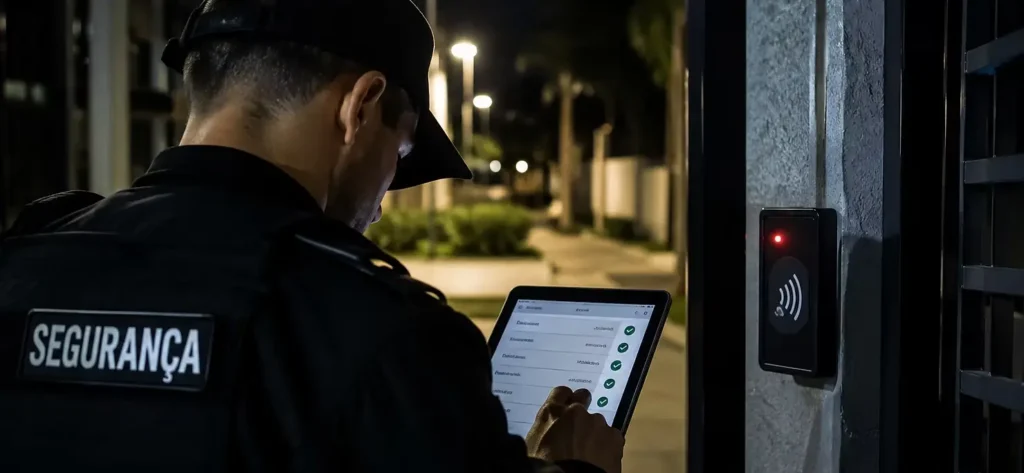
The most efficient way to resolve this issue is to adopt a QR Code check-in system at each strategic patrol point, such as the garage, leisure area, and service gate. This is exactly the type of solution HashData offers to condominiums that need real traceability in building security. The security guard scans the physical code at the exact moment they pass through that location, and the system automatically generates a record with the date, exact time, and location, making it impossible to fill in any information retroactively or approximately.
The Real Problem Behind Paper-Recorded Patrols
When patrols are still manually recorded on paper, this usually happens all at once, at the end of the shift, and not at the exact moment each passage actually occurs. In practice, this means no one is absolutely sure if the 2 AM patrol actually happened as planned, or if it was just noted down later, at the end of the shift, without real correspondence to the reported time.
This type of gap doesn’t necessarily mean the security team is slacking off. Often, it’s just a natural consequence of a process that was never designed to capture information in real-time, and that relies entirely on the goodwill and discipline of each person involved in the shift.
What the Property Manager Gains from This Type of Verification
In the event of any security incident, whether a theft, an invasion, or even an accident within the common area, the property manager will have precise records of which patrols were conducted, at what specific time, and by which professional. This information completely changes the course of an internal investigation and also strengthens any conversation with the condominium’s insurance provider, who typically requires concrete evidence before authorizing any compensation.
Furthermore, this type of control should not be understood as a way to excessively monitor the security team. On the contrary, it serves as protection for all parties involved. Residents gain the assurance that the contracted service is actually being fulfilled as agreed, and the security professional themselves gains concrete proof that they performed their job correctly, which protects them from any unfair accusations should something happen during their shift.
Why This Becomes Even More Important in Large Condominiums
In condominiums with multiple towers, several access points, and an extensive common area, it becomes practically impossible for the property manager or superintendent to personally monitor each patrol in real-time. A digital check-in system resolves precisely this limitation, allowing management to remotely track, from anywhere, whether scheduled patrols are actually being completed within the expected timeframe, without needing to be physically present all the time.
You can try HashData for free. Just visit hashdata.app and get started now.